
There’s a silly little thing I’ve been missing in my home-automation setup for ages: knowing, in real time, whether someone is having a shower. It sounds like a geek’s whim (and it is one), but it turns out to be a surprisingly useful signal… and surprisingly hard to get right.
How I detect it today (and why it doesn’t cut it)
I’ve tried all the usual indirect routes. And every one of them limps:
- Humidity arrives late. The bathroom humidity sensor doesn’t rise during the shower, but after it, when you open the screen and the steam spreads through the room. By the time the graph reacts, the shower is already over. So I learn that someone has showered; not that someone is showering.
- Hot-water demand is ambiguous. Today the only thing I really detect is when there’s hot-water demand in the house. I cross that with a presence sensor in the bathroom and a closed door, and I extrapolate that someone is probably showering. It works… sometimes. But it’s a guess: hot water also runs when you’re washing up, and presence plus a closed door don’t tell a shower apart from anything else.
- And I don’t know which bathroom. There’s more than one bathroom at home, and hot-water demand is global: it tells me someone wants hot water, but not in which shower. The moment two people shower in different bathrooms at once, the indirect signal falls apart: I know neither how many showers are running nor where.
The underlying problem is that I’m inferring something I should be able to measure. And what to measure is right there in front of me: the water running through the shower hose.
The device I’m after
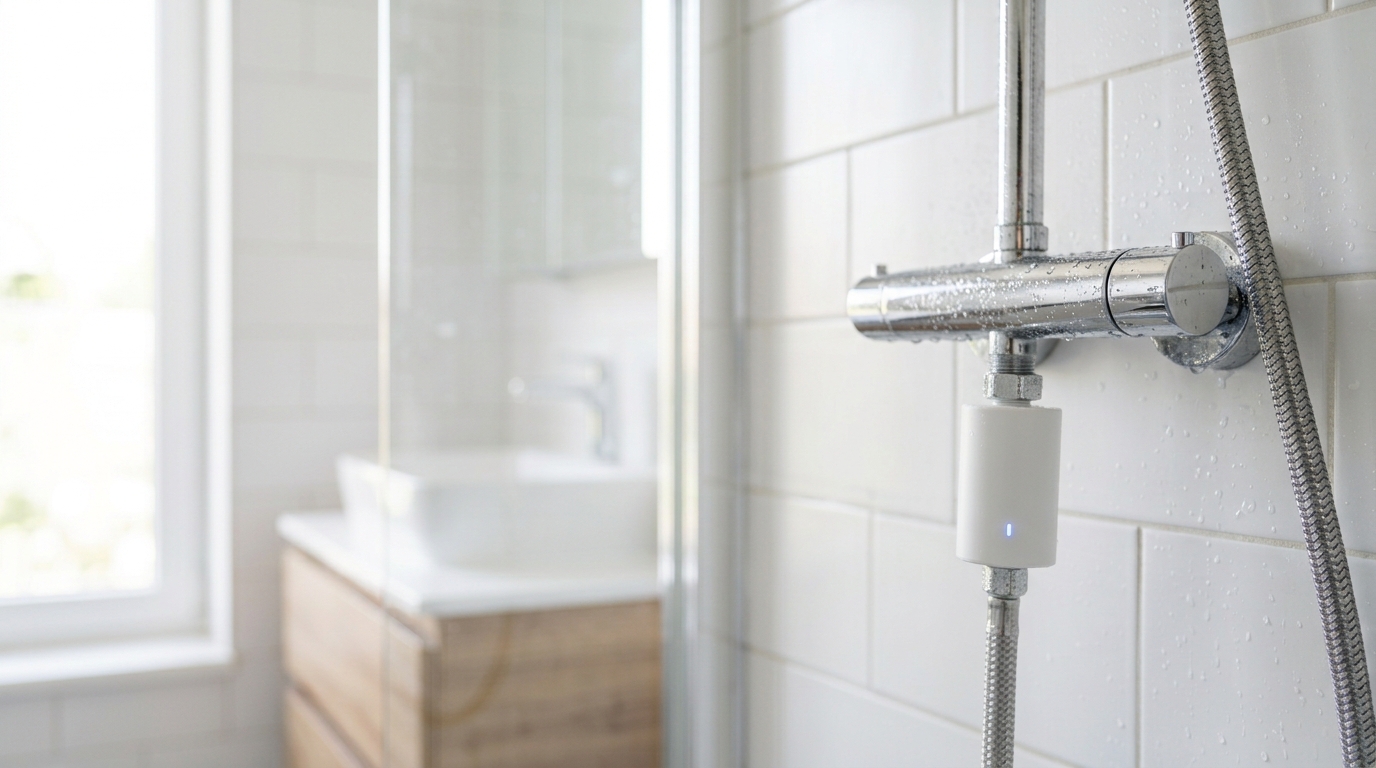
A small gadget that installs inline on the shower hose (standard 1/2″ fitting), between the tap and the shower head. No plumbing works, no wiring, no calling the plumber. And with these features:
- Self-powered by the water flow itself. A micro-turbine or internal dynamo that generates current as the water goes through. No batteries to change, no charging, no cables dangling. Let the shower power it, and that’s that.
- An internal battery (or supercapacitor). Just enough to keep the Zigbee link alive for a month with no showers. So it doesn’t drop off the network because you went away for a long weekend.
- Flow measurement. Roughly the liters per session. I don’t need billing-grade accuracy; a ballpark figure to know how much water each shower uses is plenty.
- Zigbee. Pairing straight into Home Assistant via Zigbee2MQTT or ZHA. No cloud, no account, no proprietary app in the middle.
- Waterproof and drinking-water safe. It sits inside the shower circuit: the materials have to be up to it.
What it would enable
With that direct signal, things I do half-way today (or don’t do at all) open up:
- Real presence. If water is running in the shower, someone is home. No guessing.
- I’d know which shower. One sensor per hose: I put one in each bathroom and I know exactly which is in use (and how many at once). Precisely what the global hot-water signal can’t give me.
- How many liters I spend on showers. One of the things I most want to measure, honestly: liters per shower, weekly or monthly totals, trends, who uses the most (there’s a few of us at home). Awareness through data, not through lectures.
- Honest automations. Run the extractor fan only while the shower lasts; nudge with a “you’re at 15 minutes and 90 liters”; don’t cut the bathroom heating mid-shower; check that an elderly relative comes out within a reasonable time.
- Energy. Cross the hot-water liters with the tank or boiler consumption.
Why I don’t just buy it
Because, as far as I’ve looked, the exact part doesn’t exist. What’s out there falls short somewhere:
- Flow meters are everywhere, but wired, meant for fixed pipe or industrial installation, and you have to power them separately.
- “Smart” shower heads do exist, sure, but they tend to be expensive, proprietary and tied to their cloud and app.
- Zigbee leak sensors detect water where it shouldn’t be… but they neither measure flow nor sit inline on the hose.
Nobody combines the four things I care about: cheap, Zigbee, self-powered by the water, and measuring liters. And those four, together, are what change everything.
The challenges I see
I won’t pretend it’s trivial (I don’t want it to sound like I’m asking for magic):
- Generating at low flow. The micro-turbine has to start with a normal shower stream, and without stealing any pressure you’d notice.
- Waterproofing for life. Electronics and pressurized water living together for years. No small thing.
- Zigbee in a bathroom. Tile, pipes and water aren’t the friendliest place for RF; the link has to hold.
- Sensible calibration of liters, and materials rated for drinking water.
None of it strikes me as science fiction: miniature hydro generation already exists, the turbine flow meter is an old acquaintance, and Zigbee is cheap and well proven. It’s a matter of packing it all into a small enclosure at a good price.
Throwing down the gauntlet
I’m not a hardware manufacturer, so this is exactly that: an idea put on the table in case someone picks it up. If you build devices, you’re a maker, or you move in the home-hardware world and this rings a bell, let’s talk. I’d buy it without a second thought, I’ll help test it, and I’m offering to write the Home Assistant integration and document it.
I’ve got a hunch I’m not the only one missing this part. If it’s cheap, half the home-automation world would want it. Anyone taking the gauntlet?
Leave a Reply